Let's talk about the thing nobody mentions in productivity culture.
The frameworks are everywhere. Deep work, time-blocking, second brains, morning routines, habit stacking. The productivity industry is a multi-billion dollar enterprise built on the premise that the right system can optimize human output.
And for many people, the system works — up to a point. Then something happens. The system starts to break down. Focus won't come. Motivation is absent. Output declines. The person can't explain why. They're doing everything 'right.' They're following the system. And yet.
What the productivity industry almost never talks about: the enormous cognitive and energetic cost of suppressed emotion.
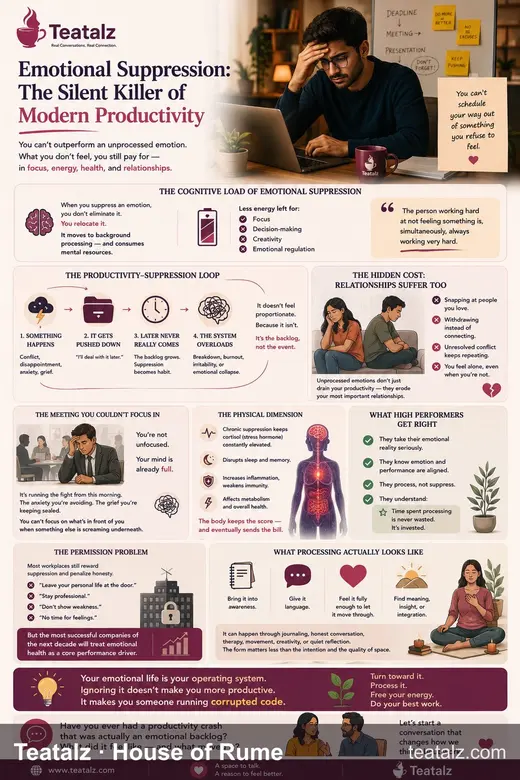
The Cognitive Load of Emotional Suppression
When you suppress an emotion — push it down, put it away, decide not to deal with it right now — you don't eliminate it. You relocate it.
It moves from conscious awareness to background processing. And like any background process on a computer, it consumes resources. Not dramatically, visibly. Quietly. Persistently.
The technical term in psychology is ego depletion — the idea that self-regulation draws on a shared pool of cognitive resources. When you spend energy suppressing feelings, you have less available for everything else. Focus, decision quality, creativity, emotional regulation in other domains.
The person who is working very hard at not feeling something is, simultaneously, always working very hard. Even when they're 'relaxed.'
The Productivity-Suppression Loop
Here's how the cycle typically goes, and you may recognize it:
Something emotionally significant happens. Conflict, disappointment, anxiety, grief. There isn't time to deal with it — there's a deadline, a meeting, a family obligation. So it gets set aside.
'I'll deal with it later.'
Later comes. The suppression is working. The emotion hasn't surfaced in any dramatic way. So the logic becomes: if I'm managing fine, I don't need to address it. Push again.
Weeks pass. The backlog grows. The background processing intensifies. A new problem arrives. The same suppression mechanism activates.
Then, without apparent cause, the system fails. The breakdown isn't proportionate to any single event. It seems to come from nowhere. The person crashes — emotionally, physically, or both. They burn out. They snap at people they love. They fall into a depression they don't understand.
This isn't weakness. It's thermodynamics. Systems operating beyond their capacity eventually fail.
The Meeting You Couldn't Focus In
Let me make this concrete. You know that meeting where you were physically present but entirely absent? Where you were going through the motions while your mind was somewhere else entirely?
Often, what's occupying the background is unprocessed emotion. A fight you had that morning that you're still running in your head. Anxiety about a situation you've been avoiding thinking about. Grief you're keeping sealed.
Your mind didn't suddenly become unfocused. It was already occupied. Full. Running at capacity on something invisible to everyone else in the room — and possibly to you.
The Physical Dimension
Emotional suppression isn't only cognitive. The body participates.
Holding something down takes continuous effort, and effort that never stops is a kind of load — the sort that shows up as broken sleep, a shorter fuse, and a tiredness that rest doesn't seem to fix. You may not connect it to the thing you're not saying. It usually is.
The entrepreneur who is 'always on' and running on cortisol doesn't feel the cost immediately. They often feel invincible — that edge of stress can feel like fuel. But the bill comes due. The body's signal system, suppressed long enough, starts delivering the messages through different channels. Illness. Injury. Collapse.
What High Performers Get Wrong
The highest-performing people I observe tend to share a counter-intuitive trait: they take their emotional reality seriously. Not because they're soft. Because they're strategic.
They understand that emotional health and performance aren't in competition — they're in alignment. That the time 'wasted' processing a difficult emotion is recouped tenfold in the cognitive resources freed up by not carrying it unresolved.
The culture of 'leave your personal life at the door' is not only unkind — it's economically irrational. You cannot compartmentalize your nervous system. You cannot ask a human brain to run on high performance while simultaneously carrying a significant unprocessed emotional load and not pay a price.
The Permission Problem
A significant part of why emotional suppression is so endemic in professional culture is that there is no permission to do otherwise.
Admitting you're struggling emotionally in most workplaces still carries professional risk. Showing that you're not fine is read as instability. Taking time for emotional processing is considered a luxury — something you do on vacation, if at all.
We have built entire organizational cultures on the premise that emotional reality should be suppressed. And then we wonder why burnout rates are at historic highs.
The most successful companies of the next decade will be the ones that understand emotional health not as an HR compliance exercise but as a core performance driver.
What Processing Actually Looks Like
Emotional processing isn't lying on a couch crying (though sometimes that's part of it). It's the act of bringing something into conscious awareness, giving it language, feeling it fully enough that it moves through you rather than getting stuck, and finding some kind of meaning or integration on the other side.
This can happen in many ways: journaling, honest conversation, therapy, physical movement, creative expression. The form matters less than the intention and the quality of the space.
What it requires, fundamentally, is that you actually turn toward the thing rather than away from it.
Productivity culture told us that feelings are inefficiencies. The truth is the opposite. Your emotional life is your operating system. Ignoring it doesn't make you more productive. It makes you someone running corrupted code.
────────────────────────────────────────────────────────────
Have you ever had a productivity crash that was actually an emotional backlog? What did it feel like from the inside — and what eventually moved it? This is a conversation that could change how we think about work.
The Internet Connected Us. But It Forgot How to Make Us Feel Heard.
Over the last few weeks, we've explored a difficult but important truth through this campaign:
People are exhausted.
Not just physically — emotionally.
We live in a world where:
• Everyone is connected, but very few people feel truly understood.
• Social media rewards performance more than honesty.
• Productivity culture celebrates output while ignoring emotional overload.
• People say “I’m fine” while carrying anxiety, loneliness, burnout, relationship struggles, and emotional backlog silently in the background.
And perhaps the most important realization of all:
Most people are not looking for diagnosis.
They’re looking for space.
Space to express.
Space to process.
Space to be heard without judgment, pressure, performance, or fear.
That’s the gap we kept coming back to.
And that’s why Teatalz exists.
But Teatalz was never built to be “just another mental health startup.”
We are building something different:
An Emotional Social Media Ecosystem.
A positivity-first digital space designed around emotional expression instead of emotional exploitation.
Traditional social media platforms optimized the internet for attention.
We believe the next generation of platforms will optimize it for emotional wellbeing.
That means:
• Depth over virality
• Listening over broadcasting
• Expression over performance
• Presence over engagement addiction
• Human connection over endless scrolling
At Teatalz, the goal isn’t to keep people trapped on a platform.
The goal is to help people leave feeling lighter, calmer, clearer, and less alone.
Because emotional wellbeing should not feel clinical.
It should feel human.
We don’t believe every difficult emotion needs to become a diagnosis.
We don’t believe vulnerability should be turned into content for algorithms.
And we don’t believe emotional support should only exist after someone reaches a breaking point.
Sometimes people simply need:
• A safe space to express themselves
• A listener without judgment
• A moment of emotional clarity
• A reminder that they are not alone in what they feel
That is the ecosystem we are building.
An internet experience designed not around outrage, comparison, and addiction —
but around emotional honesty, warmth, reflection, and meaningful human connection.
This isn’t anti-technology.
It’s technology evolving.
The future of digital platforms will not only understand what users click.
It will understand what users feel.
And the platforms that matter most in the next decade won’t be the ones that capture the most attention —
they’ll be the ones that improve the emotional quality of people’s lives.
That shift has already begun.
And Teatalz wants to help build it —
one real conversation at a time.
Join our waiting list to be part of our family before the world knows us