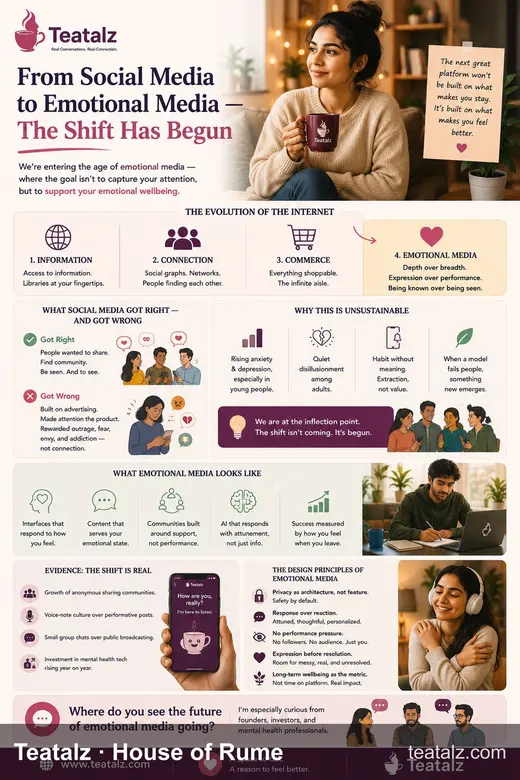
Every decade or so, the internet reinvents itself around a new organizing principle.
The first internet was about information. Access. Libraries at your fingertips.
The second internet was about connection. Social graphs. Networks. People finding each other at scale.
The third internet was about commerce. Everything shoppable. The infinite aisle.
And now, something else is beginning.
We are entering the age of emotional media.
What Social Media Got Right — and What It Got Wrong
Social media solved a real problem. People wanted to share their lives. They wanted to find community across geography. They wanted to be seen and to see.
What it got wrong — profoundly, structurally wrong — was the incentive system. By building on advertising revenue, social media made attention the product. And attention is easiest to capture through emotional arousal — outrage, envy, fear, desire.
Not connection. Not expression. Not the kind of emotional reality that makes people feel genuinely less alone.
The result: we built the largest communication infrastructure in human history, and used it primarily to make people feel inadequate, divided, and addicted.
Why This is Unsustainable
The cracks are visible everywhere now.
Whether these platforms have damaged teenage mental health is genuinely contested among researchers — the association turns up repeatedly, the causal claim is not settled. What is not contested is that none of them were designed with emotional wellbeing as a goal in the first place. Adults are quietly disillusioned — they use the platforms out of habit but get less from them than they once did. The model that was once a revolution now feels, to many, like an extraction.
Something new always arises when the dominant model begins to fail the people it was supposed to serve.
We are at that inflection point.
What Emotional Media Looks Like
Emotional media is not a single platform or product category. It's a design philosophy — and increasingly, a user expectation.
It looks like this: spaces designed for depth over breadth. For expression over performance. For being known over being seen.
It means interfaces that respond to how you feel rather than just what you search for. Content that is calibrated to your emotional state — not to manipulate it for engagement, but to serve it. Communities built around mutual support rather than shared identity performance. AI that responds with attunement rather than just information.
It means measuring success not by time on platform but by how the user feels when they leave.
That's a radical inversion of the current model. And it's precisely what the market is beginning to demand.
The Evidence That This Shift is Real
Look at where user behavior is moving. The explosive growth of anonymous sharing communities. The popularity of voice-note culture as an alternative to performative text posts. The return to smaller, more intimate group chats over public broadcasting.
People are moving toward depth. They're trying to find it within existing platforms — and finding the architecture inhospitable. The demand is real. The supply hasn't caught up.
In the startup ecosystem, investment in mental health tech has grown substantially year on year. Not because investors are suddenly altruistic, but because they've identified the same gap the users are feeling. There's a large, underserved need. And underserved needs, in technology markets, become products.
The Design Principles of Emotional Media
What would a platform built for emotional wellbeing actually look like, if designed from first principles rather than retrofitted from an engagement model?
Privacy as architecture, not feature: The default must be safety. You don't opt into confidentiality — it's the foundation everything is built on.
Response over reaction: Instead of like buttons and comment sections, the core interaction is response — attuned, thoughtful, personalized to what was actually shared.
No performance pressure: No follower counts. No viral mechanics. No audience. Just the experience of being heard.
Expression before resolution: The platform shouldn't rush users toward 'fixed.' It should create space for the messy, unresolved, hard-to-name reality of how people actually feel.
Long-term wellbeing as the metric: Not daily active users. Not time on platform. How people feel. What they do differently because of the interaction. Whether they came back not out of addiction but out of genuine value.
Why Now
The convergence of three things makes this moment right for emotional media to emerge:
AI has reached the level of sophistication where empathetic, attuned conversation at scale is technically possible for the first time.
User disillusionment with extractive social media has hit a critical mass, creating genuine appetite for something different.
Mental health awareness — particularly among younger demographics — has reached a point where the conversation about emotional wellbeing is no longer taboo but expected.
The shift isn't coming. It's begun.
The question is who builds the infrastructure — and whether they build it with the user's emotional reality at the center, or with engagement metrics where the user's heart should be.
We believe the next great platform isn't built on what makes you stay. It's built on what makes you feel better for having been there.
────────────────────────────────────────────────────────────
Where do you see the future of emotional media going? I'm especially curious from founders, investors, and mental health professionals in the room. This is one of the most important design challenges of our time.