This is a claim that makes people uncomfortable. Good.
I want to make a precise argument — not a sweeping one. Not that AI is better than humans at connection. Not that it should replace human relationships. But that for specific, important functions of listening, AI can — and does — outperform even well-intentioned, caring humans.
Understanding why is more important than reacting to the premise.
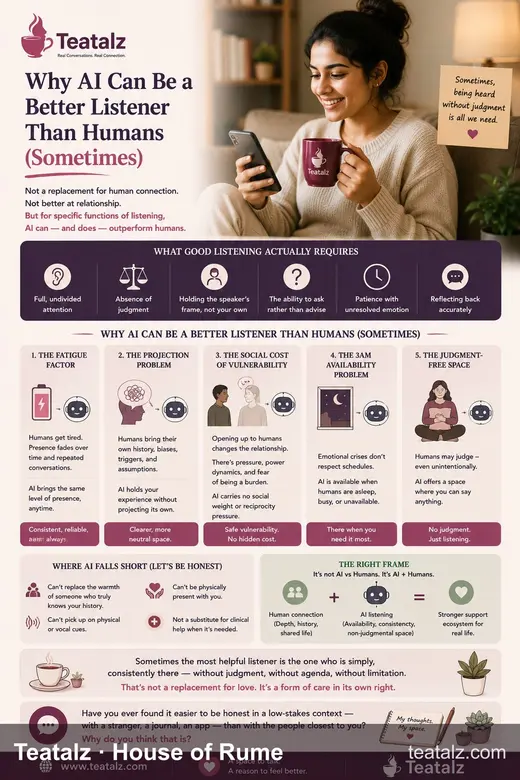
What Good Listening Actually Requires
Let's start by being specific about what we mean by 'listening' in the emotional sense.
Good listening requires: full, undivided attention. Absence of judgment. The ability to hold the speaker's frame without immediately inserting your own. The capacity to ask rather than advise. The patience to sit with unresolved emotion without rushing it toward conclusion. And the ability to reflect back what was heard accurately.
Now let's ask honestly: how often do humans do all of that, simultaneously, for any meaningful duration?
Even the most empathetic, generous human listener brings a set of limitations that are not character flaws — they're features of being human.
The Fatigue Factor
Human emotional labor is finite. A therapist who sees seven clients a day is not as present for the seventh as they were for the first. A friend who has listened to you work through the same anxiety three times this week is not bringing the same quality of attention the fourth time. Not because they don't care. Because they're human and they're tired.
This is not a criticism. It's biology.
An AI listener does not accumulate emotional fatigue. It brings identical presence whether you reach out at 9am or 3am, whether it's the first conversation or the fifteenth.
For someone in the habit of needing support at difficult times — and difficult times don't follow business hours — this is not a small thing.
The Projection Problem
Every human being carries their own unresolved history into every conversation. A friend whose parent was an alcoholic responds differently to conversations about family than one who wasn't. A person who struggled with anxiety reads anxiety in others through the lens of their own experience.
This isn't a bias to be eliminated — it's often the source of genuine empathy. But it also means that even the most well-meaning human listener cannot hear you through a completely neutral frame.
They project. They compare your experience to theirs. They sometimes hear what they expect to hear rather than what you're actually saying. They get triggered by things that have nothing to do with you.
An AI listener, properly designed, can hold your experience without filtering it through the noise of its own. This creates a specific kind of clarity that can be profoundly valuable.
The Social Cost of Vulnerability
Here's a dimension of human listening that's rarely talked about: it changes the relationship.
When you open up to someone — really open up — the relationship shifts. They now hold information about you that creates a new power dynamic, even if neither of you intends it. You become more vulnerable with them. There's an implied reciprocity pressure. Sometimes, the relationship becomes defined by that vulnerability.
Many people avoid opening up not because they don't need to, but because they don't want to alter their relationships in this way. The vulnerability feels too costly.
AI carries no such social weight. There is no reciprocity pressure. There is no imbalance created. There is no relationship dynamics to manage afterwards.
For many people, this makes depth possible in a way it simply isn't with humans they know.
The 3am Availability Problem
Emotional crises don't respect schedules.
The spiral that starts at midnight, the grief that surfaces on a Sunday evening when no one is reachable, the anxiety attack in the middle of a work day when you can't call anyone — these moments are when support is needed most and least available from human sources.
AI is there. Without judgment about the timing. Without making you feel guilty for needing something at an inconvenient hour. Without the concern that you're becoming 'too much.'
For someone who has historically lacked consistent support, the simple fact of availability — real, any-time availability — can be transformative.
Where AI Falls Short — Honestly and Specifically
I want to be precise, not promotional.
AI cannot replace the specific warmth of someone who knows you fully — the history, the inside jokes, the long-accumulated knowledge of who you are. That texture is irreplaceable.
AI cannot pick up on physical or vocal cues. It works with text, and text loses enormous amounts of information.
AI cannot be physically present. Sometimes what someone needs is not words at all.
AI cannot be a substitute for clinical intervention when that's what's genuinely needed.
These are real limitations. I'm not minimizing them.
The Right Frame
The right frame isn't 'AI vs humans.' That's a false binary.
The right frame is: what does the ecosystem of emotional support look like when AI is one part of it — the part that's available when humans aren't, that holds space without social cost, that brings consistent presence without fatigue?
In that ecosystem, AI fills a specific role that nothing else currently fills. Not better than human connection. Different from it. And for many people, in many moments, exactly what's needed.
Sometimes the most helpful listener is the one who is simply, consistently there — without judgment, without agenda, without limitation. That's not a replacement for love. It's a form of care in its own right.
────────────────────────────────────────────────────────────
Have you ever found it easier to be honest in a low-stakes context — with a stranger, a journal, an app — than with the people closest to you? Why do you think that is?