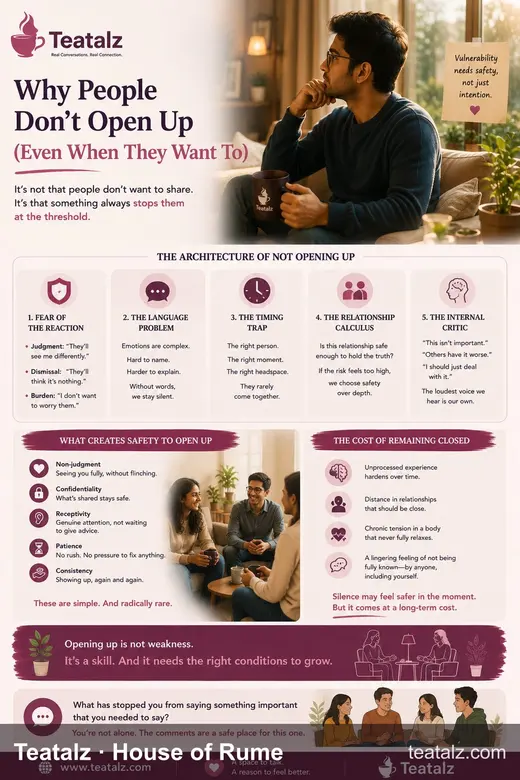
There's a specific kind of silence that's louder than noise.
It's the silence of the person in the room who has something real to say — something important, something they've been carrying — and doesn't say it. Not because they don't want to. But because something stops them at the threshold, every single time.
This is one of the most universal and least examined human experiences. And understanding it might be one of the most important things we can do.
The Architecture of Not Opening Up
When we examine why people don't share what they're actually feeling, the reasons break into a few distinct categories — each with its own psychology.
Fear of the Reaction
The most common blocker is anticipatory fear — imagining the response before it happens, and deciding it won't be worth it.
People fear judgment: that if they reveal the messy, contradictory, or socially unacceptable parts of what they feel, they'll be seen differently. That the relationship will shift. That they'll lose something they can't get back.
People fear dismissal: perhaps the most painful response to vulnerability isn't hostility — it's being brushed off. 'Everyone feels that way.' 'You're overthinking it.' 'It's not that bad.' These responses don't just fail to help — they actively teach the person that opening up is unsafe. That their experience isn't important enough to receive full attention.
People fear burden: particularly among those who have been cast in the role of the strong one, the capable one, the person others lean on. Opening up feels like it violates a contract. Like it will worry or overwhelm the people they love.
The Language Problem
A less obvious but enormously significant barrier is the difficulty of translating felt experience into words.
Emotions, especially complex or layered ones, don't come pre-labeled. 'I feel sad' is an approximation. The actual experience might be something like: a combination of grief for something I didn't know I'd lost, overlaid with guilt for feeling it, mixed with a kind of ambient dread that I can't locate a specific cause for.
That's not easy to say. It's not even easy to think. And without the language, many people simply don't try. They shrug. They say they don't know how they're feeling. They change the subject.
This is not avoidance in the clinical sense. It's often simply the absence of the emotional vocabulary needed to start.
The Timing Trap
Opening up requires the convergence of several factors that rarely align in modern life: a person you trust, a moment that feels right, an emotional readiness to go there, and a context that makes depth feel appropriate.
Modern social contexts are almost universally designed against depth. Dinner conversations have screens. Coffee chats have time limits. Work interactions have professional norms. Family gatherings have old dynamics that make honesty feel risky.
Even when someone wants to have a real conversation, the environment actively resists it. There's always somewhere to be, something to check, someone who might overhear.
The Relationship Calculus
For many people, emotional openness involves a complex unconscious calculation: is this relationship strong enough to hold this truth?
If the relationship feels fragile, uncertain, or conditional — if the person isn't sure they'll be met with warmth — the calculation often resolves against sharing. Not because they don't want to, but because the risk feels too high.
And here's the painful paradox: the same protective calculation that prevents the share also prevents the relationship from deepening. Because depth is built through mutual vulnerability. By not sharing, you keep the relationship exactly where it is — functional but not intimate. Safe but not nourishing.
The Internal Critic
One of the least discussed barriers is the internalized critic — the inner voice that pre-judges and pre-dismisses before anyone else gets the chance.
'This isn't important enough to bring up.' 'Other people have real problems.' 'I should just deal with it.' 'I'm probably being too sensitive.' 'It'll pass.'
This voice is often the loudest room in the house. And it has often been built from years of having emotional expression minimized, ridiculed, or ignored. The outer dismissal has been internalized so thoroughly that the person now dismisses themselves before anyone else can.
What Creates Safety to Open Up
If we understand the barriers, we understand what dismantles them.
Non-judgment — not as a stated value but as a demonstrated practice. The person who has shown, repeatedly, that they can hold complexity without flinching.
Confidentiality — the knowledge that what is shared won't travel. That vulnerability won't become gossip or a story someone tells later.
Receptivity — the sense that there is genuine attention available. That the listener isn't waiting for their turn or mentally calculating advice.
Patience — that there's no rush. That the conversation doesn't need to resolve into something neat before time runs out.
These are simple requirements. They're also radically rare.
The Cost of Remaining Closed
Not opening up has a price. It's paid slowly, over years, in the currency of unprocessed experience.
The things we don't say don't dissolve. They calcify. They become the baseline tension in a body that never fully relaxes. The distance in relationships that should be close. The persistent vague sense that you're not fully known by anyone — including yourself.
Opening up is not weakness. It is a skill, and like all skills, it requires the right conditions to develop.
The question isn't whether you want to open up. Most people do. The question is whether the spaces in your life — and in the world — are genuinely built to receive you.
────────────────────────────────────────────────────────────
What has stopped you from saying something important that you needed to say? I think you'll find you're in vast company. The comments are a safe place for this one.