Let me say something that might be uncomfortable.
Not everyone carrying something heavy is unwell. And sometimes it is treatment they need — that matters, and this isn't a post about avoiding help.
But far more often, what's missing is simply one person who will truly listen.
And I mean truly listen — not fix, not advise, not redirect. Just hold space.
That's it.
The Listening Deficit is Real
Think about the last time you opened up to someone about how you were actually feeling — not the surface-level 'I'm a bit stressed' kind, but the deep, messy, hard-to-articulate kind. How did that conversation go?
If you're like most people, you got one of these responses:
"Oh don't worry, everyone goes through this."
"Have you tried journaling? Meditation? Exercise?"
"You should talk to a professional about this."
All well-meaning. All deeply missing the point.
Because when you open up, you're not always asking for solutions. You're asking to be seen. To be heard. To have your reality acknowledged without someone rushing you toward a fix.
Why We Confuse Listening With Advising
We live in a productivity-obsessed culture. The moment someone shares a problem, our instinct is to solve it. We treat emotional pain the way we treat a broken laptop — identify the bug, patch it, get back online.
But human emotion isn't a bug. It's data.
When you feel anxious, your mind is trying to tell you something. When you feel hollow inside despite having everything, that emptiness is pointing somewhere important. When you snap at the people you love, there's something underneath that — fatigue, unmet needs, buried grief.
The answer isn't always therapy. Sometimes it's just someone sitting with you in that discomfort and saying: 'I hear you. That sounds hard. Tell me more.'
The Research Backs This Up
One of the most consistent findings in psychotherapy research is that the quality of the relationship matters at least as much as the technique — that being properly heard isn't a preliminary to the work, it's much of the work.
Carl Rogers, the founder of humanistic psychology, spent his career arguing that three things are enough to transform a person's emotional state: empathy, unconditional positive regard, and authenticity.
Notice that none of those require a clinical degree.
What they require is presence. Genuine, undivided, non-judgmental presence.
And in 2026, that might be the rarest resource on the planet.
So Why Are We Starving for It?
We have more communication tools than ever. WhatsApp. Instagram DMs. Voice notes. Video calls. The infrastructure for human connection is everywhere.
But the quality of listening has collapsed.
Your friends are scrolling while you talk. Your family is already preparing their counter-argument before you've finished your sentence. Your partner is tired. Your colleague doesn't have the bandwidth. Your social media feed offers sympathy in the form of reaction emojis, which vanish in a day.
We're more connected and more unheard than any generation before us.
The Therapy Gap Nobody Talks About
Here's the uncomfortable truth about the mental health system: there is nowhere near enough of it, and what exists is rightly pointed at the sharpest need first.
Therapy does a great deal — diagnosis and crisis care, but also the ordinary work of understanding yourself, which plenty of people go to it for. What no system this size can absorb is the daily, ambient emotional weight most of us carry — the low-grade loneliness, the quiet frustration, the unprocessed grief of small disappointments, the anxiety of a world that never slows down.
For that middle space — between 'I'm fine' and 'I need professional help' — there's almost nothing.
And that gap is where millions of people are living, quietly struggling, every single day.
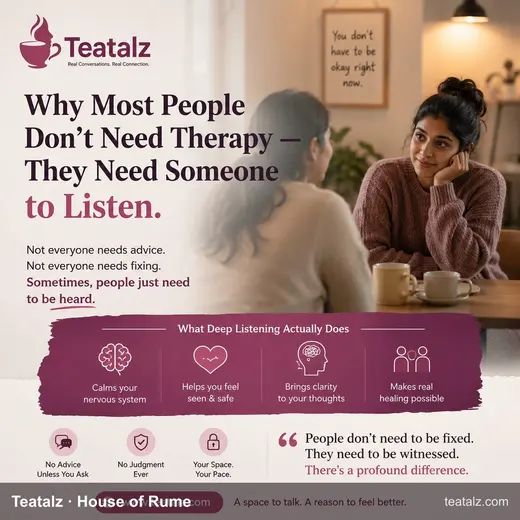
What Deep Listening Actually Does
When someone really listens, you can feel something in you unclench. You think more clearly afterwards. Most people know the feeling; it doesn't need a diagram.
You start to hear yourself.
And that's where the real healing begins — not in someone else's advice, but in the clarity that comes from voicing your experience out loud to someone who isn't going anywhere.
People don't need to be fixed. They need to be witnessed.
There's a profound difference.
The Shift That Needs to Happen
We need to stop treating emotional expression as a prelude to diagnosis. Not every person who wants to talk about their feelings needs a clinical intervention. Not every conversation about sadness should end with a referral.
Sometimes the most powerful thing you can say to someone is: 'You don't have to be okay right now.'
We need spaces — real, safe, consistent spaces — where people can be emotionally honest without judgment, without unsolicited advice, and without the pressure to perform recovery for an audience.
That's not therapy. That's humanity.
And we've somehow made it the hardest thing to find.
A Final Thought
The next time someone you care about starts to open up — pause. Take a breath. Put your phone down.
Don't fix it. Don't rush it. Don't minimize it.
Just listen.
You might not realize it in the moment, but you could be giving someone something they haven't received in a very long time.
And if you're the one who needs to be heard right now?
You deserve a space where that's not just possible — it's the whole point.
────────────────────────────────────────────────────────────
What's the last time someone truly listened to you without offering advice? Drop it in the comments — I read every single one.