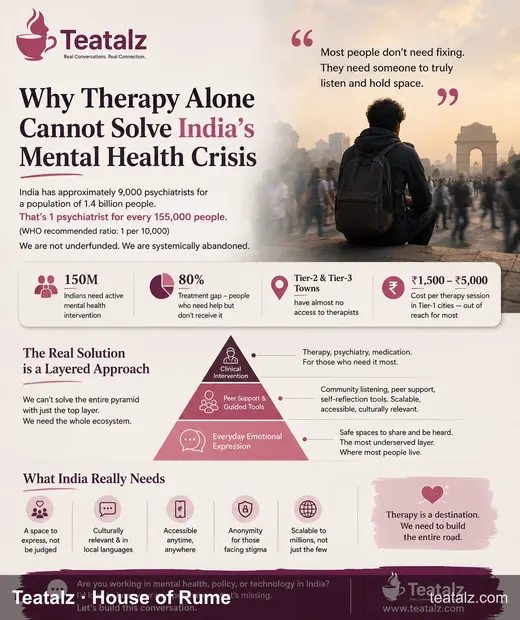
India has roughly 0.75 psychiatrists for every 100,000 people — one for every 133,000 (Indian Journal of Psychiatry, 2019, which counted about 9,000 psychiatrists nationally).
Let that sink in.
We are not short of the target by a little. We are short of it by a multiple. In high-income countries the figure is more than ten times ours.
We are not underfunded. We are systemically abandoned.
The Scale of What We're Dealing With
The National Mental Health Survey (2015–16) estimated that nearly 150 million Indians were in need of active mental health interventions. The treatment gap — people who need care and never receive it — runs between 70% and 92%, depending on the condition.
Even at the low end, that is most people.
We are not talking about a minority issue. We are talking about a national crisis that is hiding in plain sight, tucked behind productivity metrics, hustle culture narratives, and our cultural conditioning to keep family matters private.
Why Therapy, As a System, Cannot Scale to This Problem
Therapy is extraordinary. It saves lives. But let's be honest about its structural limitations:
Cost: A single private session in a metro costs more than many households spend on food in a week. Weekly therapy is not a budget line most families have. For the vast majority of India's population, this is not accessible.
Availability: Most qualified therapists are concentrated in metro cities. Someone in Tier-2 or Tier-3 towns is essentially without options.
Stigma: In a culture where mental illness is often equated with madness, families actively resist professional help. The idea of 'going to a therapist' still carries the weight of shame in much of urban and almost all of rural India.
Volume: Even if money and stigma weren't issues — there simply aren't enough therapists. If every available therapist in India worked eight hours a day, they could not serve even a fraction of those who need support.
Therapy is a resource. And like all scarce resources, it reaches the privileged first.
The Myth of 'Just Get Help'
The mental health conversation in India has made significant progress in the last decade. Celebrities speak openly about depression. Startups talk about employee wellness. Social media campaigns remind us to check on our 'strong friend.'
This is good. This is necessary. But it has also created a dangerous illusion.
The illusion that the infrastructure exists. That 'help is available' to anyone who asks. That if someone is suffering, it's partly their fault for not reaching out.
It is not.
When a first-generation college student from a small town in Bihar feels chronically overwhelmed and lonely, telling them to 'get therapy' is not a solution. It's a dismissal wrapped in progressive language.
What We Actually Need — A Layered Approach
The real solution to India's mental health crisis isn't more therapy alone — it's building the entire ecosystem that leads to therapy when needed, and serves people who don't yet need clinical intervention.
Think of it as a pyramid:
At the base: Everyday emotional expression and processing. Safe spaces where people can share how they feel without judgment. This is the most underserved layer. This is where most people live.
In the middle: Peer support, community listening, guided self-reflection tools. Scalable, culturally relevant, and accessible across languages and geographies.
At the top: Clinical intervention. Therapy, psychiatry, medication management. Reserved for those who need it most.
Right now, we're trying to solve the entire pyramid with only the top layer.
The Cultural Dimension Nobody Is Talking About
Indian emotional culture is complex. We are a society that simultaneously glorifies 'adjustment' and undervalues emotional honesty. Joint families that were historically support systems have fractured. Migration has separated communities. The joint family dinner has been replaced by individual screens in individual rooms.
We are lonelier than we've ever been. And we have no cultural script for that.
Our grandparents dealt with grief through ritual, community, and continuity. We deal with it by doomscrolling at 2am and pretending we're fine at work by 9.
No amount of clinical infrastructure fixes that cultural displacement. It requires something more fundamental — a reimagining of how we relate to our own inner lives and to each other.
Technology Is Not the Problem — It's Part of the Answer
The instinct is to say that screens have made us more isolated. And there's truth to that. But technology, designed intentionally, can also be the bridge across the access gap that has historically kept mental wellness a privilege.
Consider the possibilities: regional language support, 24/7 availability, zero commute, cultural context, anonymity for those navigating stigma, and the ability to scale to millions simultaneously.
Not as a replacement for therapy. As the base of the pyramid. As the first and most accessible layer of support that doesn't yet exist.
A Different Kind of Platform
India doesn't need another meditation app. It doesn't need another hotline. It doesn't need another list of therapists you can't afford.
It needs a space where people can simply express what they're going through — and be heard. Without diagnosis, without judgment, without the pressure to be 'okay' on a timeline.
The crisis in India is real. The gap in the system is real. And the opportunity to build something that actually addresses it — not from the top down, but from the ground up — is equally real.
Therapy is a destination. We need to build the entire road.
────────────────────────────────────────────────────────────
Are you working in mental health, policy, or technology in India? I'd love to hear your perspective on what's missing. Let's build this conversation.