Let's settle something that sits at the intersection of neuroscience, philosophy, and technology — and tends to generate more heat than light.
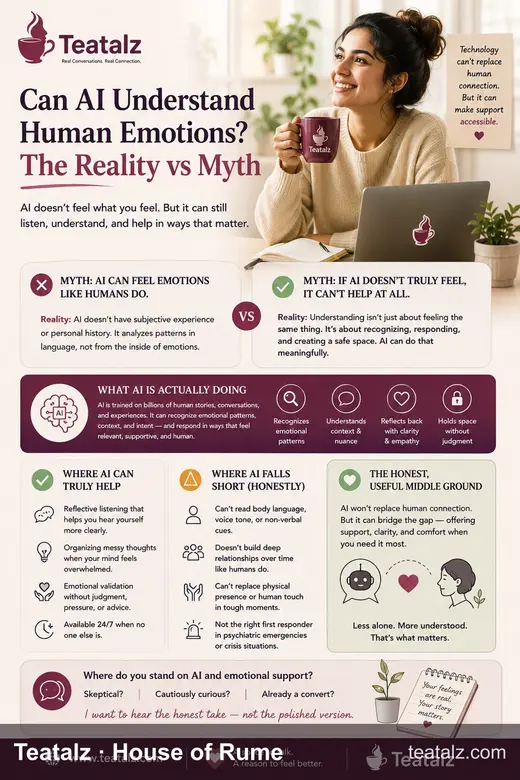
Can AI understand human emotions?
The answer, like most things worth thinking about carefully, is: it depends entirely on what you mean by 'understand.'
The Strong Claim and Why It's Wrong
The strong claim is that AI can understand emotions the way humans do — through embodied experience, personal history, the felt sense of what it is to be hurt or joyful or afraid.
This claim is false. Current AI does not have subjective experience. It doesn't feel what it's processing. When it outputs language about grief or joy, it's working from patterns in text, not from the inside of an experience.
Anyone telling you otherwise is either confused or selling something.
The Dismissive Counter-Claim and Why It's Also Wrong
The counter-claim — the one from AI skeptics — is that because AI doesn't 'truly' feel, it can't meaningfully engage with human emotions at all.
This is also wrong, and in a more practically damaging way.
Consider: a highly skilled therapist who has never personally experienced addiction can still help someone through recovery. A grief counselor who hasn't lost a child can still offer meaningful support to bereaved parents. The absence of identical personal experience doesn't eliminate the capacity for understanding.
Understanding, in the context of emotional support, isn't just about having felt the same thing. It's about recognizing patterns, responding appropriately, creating safety, asking the right questions, and reflecting experience back with accuracy and warmth.
Those are things AI can do. Not perfectly. Not the way a deeply attuned human can. But meaningfully enough to matter.
What AI Is Actually Doing When It 'Understands' Emotions
Modern large language models have been trained on essentially all of written human experience — billions of texts in which humans have tried to articulate what they feel and why. Novels. Therapy transcripts. Personal essays. Forum posts at 3am. The entire corpus of human beings trying to put inner experience into words.
From this, they've developed something functionally similar to emotional pattern recognition at scale. They can identify that certain linguistic patterns are associated with grief, that certain others suggest suppressed anger, that certain conversational structures indicate someone is seeking validation rather than advice.
Is that understanding? In a strict philosophical sense, probably not. In a functionally useful sense, absolutely.
The Mirror Effect and Why It Matters
One of the most powerful mechanisms in therapy is something called reflective listening — the therapist mirrors back what they've heard, often in slightly different words, in a way that helps the speaker hear themselves.
It sounds simple. It's extraordinarily difficult to do well. And it's transformative when it happens.
AI is genuinely good at this. Not because it 'feels' what you're feeling, but because it can hold the full content of what you've said, identify the emotional undertones, and reflect them back without the interference of the listener's own emotional noise.
Human listeners — even excellent ones — bring their own histories, triggers, and anxieties to every conversation. An AI listener brings none of that. That's not a weakness. For many purposes, it's a feature.
Where AI Falls Short — Honestly
I want to be specific about the real limitations, because vague reassurances aren't helpful.
AI cannot read non-verbal cues. The tremor in someone's voice, the way their body closes in on itself, the micro-expression of something that contradicts what they're saying — these are lost. This matters.
AI doesn't build relationship over time the way humans do. The accumulated history, the in-jokes, the reference points — these give human relationships their depth. Even with memory features, AI relationships have a different texture.
AI cannot be present in the physical sense. Sometimes what a person needs is a hand on the shoulder. The weight of another body in the room. The confirmation of another physical presence. No technology substitutes for that.
And there will always be moments of crisis — genuine psychiatric emergency, risk of self-harm — where AI is the wrong first responder.
The Honest, Useful Middle Ground
AI won't replace human emotional connection. It shouldn't try.
But it can extend access to something that looks enough like understanding to help people feel less alone, process what they're going through, and find enough clarity to take the next step — whether that's talking to a friend, booking a therapy appointment, or simply sleeping better.
For a world where billions of people have no access to consistent emotional support, this isn't a consolation prize.
It's a revolution.
The question isn't whether AI can feel what you feel. The question is whether it can help you feel less alone. And the answer to that — more and more — is yes.
────────────────────────────────────────────────────────────
Where do you stand on AI and emotional support? Skeptical? Cautiously curious? Already a convert? I want to hear the honest take — not the polished version.