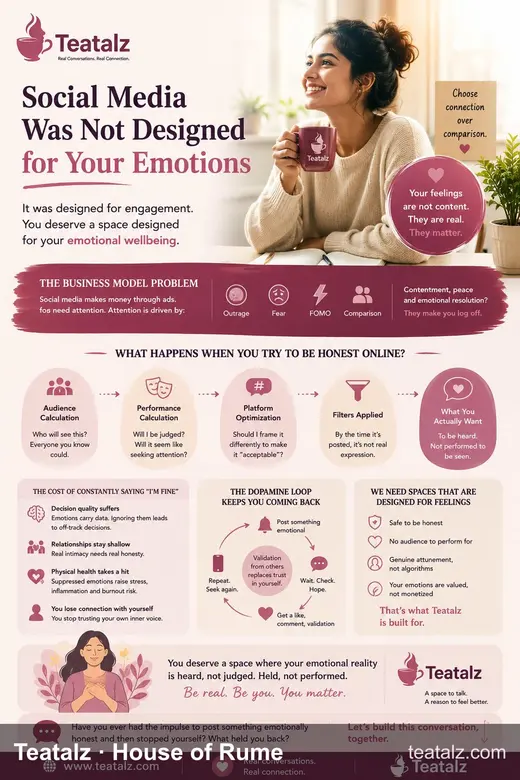
Here is a fact that doesn't get said clearly enough: every major social media platform was built by engineers optimizing for engagement metrics, not emotional wellbeing.
That's not a moral judgement. It's a design reality.
When Instagram was built, the question wasn't 'how do we make people feel heard?' It was 'how do we make people come back?' When Twitter evolved, the incentive wasn't 'how do we facilitate genuine emotional expression?' It was 'how do we maximize time on platform?'
Engagement and emotional health are not the same thing. And in many cases, they're directly opposed.
The Business Model Problem
Social media platforms make money through advertising. Advertising revenue scales with attention. Attention is maximized through emotional arousal — specifically, the emotions that make you scroll rather than the emotions that make you feel settled.
Outrage keeps you scrolling. Fear keeps you scrolling. FOMO keeps you scrolling. The carefully curated happiness of others — triggering comparison, aspiration, mild inadequacy — keeps you scrolling.
Contentment, peace, emotional resolution? Those make you put the phone down. And a user who puts the phone down is, from a business perspective, a less valuable user.
This is not conspiracy. It's economics. And it has enormous consequences for how we experience our emotional lives online.
What Happens When You Try to Be Emotionally Honest on Social Media
Let's imagine you're having a genuinely hard week. You're lonely, overwhelmed, and you want to express something real. You consider posting something honest.
Before you hit publish, here's what happens in your brain:
First, the audience calculation. Everyone you've ever met might see this. Your boss. Your ex. That person from school you haven't spoken to in eight years. Your parents. Future employers.
Then, the performance calculation. Will this come across as seeking attention? Will it seem dramatic? What will people think of me? Will I get the response I'm hoping for — or worse, no response at all?
Then, the platform optimization. Should I add a photo? A hashtag? Frame it as a 'lesson learned' so it's more palatable? Turn my pain into content so it's consumable rather than just honest?
By the time you've run your authentic emotional experience through those filters, what remains isn't expression. It's a performance of expression. Which is something entirely different.
Vulnerability as Content
A particular strain of social media culture has emerged in response to the authenticity problem — the vulnerability post. The 'I used to struggle but now I'm better' narrative. The carefully photographed moment of rawness.
I want to be clear: this can be genuinely valuable. Seeing others share their struggles normalizes them. People have felt less alone because of honest posts.
But there's a difference between vulnerability as connection and vulnerability as content. The former is messy, unresolved, and sometimes uncomfortable. The latter is structured, has a narrative arc, and typically ends with a lesson or a call to action.
The algorithm doesn't reward the messy kind. It rewards the neat kind. So what you see, mostly, is the neat kind. And what you compare your inner life to is other people's edited highlight reel of their worst moments.
The Comparison Engine
Even when social media isn't explicitly emotional, it operates on comparison. Every post is an implicit data point: here is how this person's life looks, feels, and measures up.
Comparison isn't inherently bad. It's a fundamental human mechanism for calibration. But social media has supercharged it in a specific and damaging direction: upward social comparison, at infinite scale, with perfectly optimized images.
You are not comparing yourself to your neighbor anymore. You are comparing yourself to the most impressive, most aesthetically pleasing, most compelling version of thousands of people simultaneously. Every day. Multiple times a day.
This is an entirely new psychological phenomenon in human history. We have not evolved to handle it. And the emotional fallout — inadequacy, anxiety, the persistent low-level sense that your life isn't quite enough — is real.
The Dopamine Loop That Keeps You Coming Back
Social media has weaponized the brain's reward system in ways we're still fully understanding. The notification, the like, the comment — each one is a micro-dose of social validation. And like all variable reward systems, the uncertainty of whether the reward will come is more addictive than the reward itself.
This is the same mechanism behind slot machines.
So you post something emotional. You wait. You check. Did anyone respond? Do people care? The waiting is excruciating. The silence is painful. The three-word comment is inadequate. And the whole cycle trains you to seek validation from an audience rather than from your own felt sense of truth.
This is not how emotional processing works. It's how emotional dependency works.
We Need Spaces That Were Actually Designed for Feelings
The solution isn't to leave social media. For most people, that's neither practical nor even desirable.
The solution is to stop asking social media to do something it was never designed to do — hold your emotional reality safely.
We need spaces that were built specifically for that. Spaces where the incentive is not engagement but honesty. Where there's no audience to perform for. Where the 'algorithm' is replaced by genuine attunement. Where your emotional experience is treated as inherently valuable, not as raw material for content.
Social media is many things. It connects, informs, entertains, mobilizes.
It just was never built to hold your heart. And we need to stop expecting it to.
────────────────────────────────────────────────────────────
Have you ever had the impulse to post something emotionally honest and then stopped yourself? What held you back? I'd be curious to hear — this is a conversation worth having publicly.