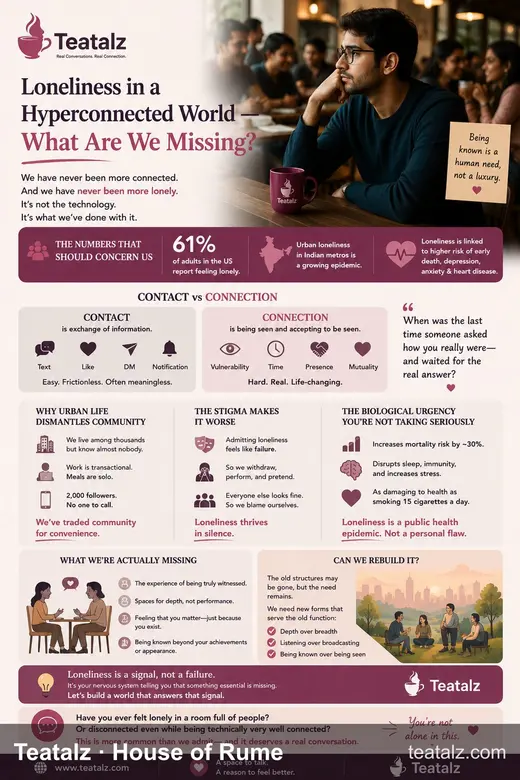
We have never been more connected. And we have never been more lonely.
This is not a contradiction once you understand the difference between connection and contact.
The Numbers That Should Concern Us
In Cigna's 2020 US loneliness survey, 61% of around 10,000 adults scored as lonely on the UCLA Loneliness Scale — up seven points in two years. India, despite its reputation for communal living and tight social fabric, is not immune. Urban loneliness in Indian metros is a growing and largely undiscussed epidemic.
The irony is not lost: the generation with more ways to communicate than any before it is reporting the highest rates of loneliness in recorded history.
Something fundamental has broken. And it's not the technology. It's what we've done with it.
Contact vs Connection: The Critical Difference
Contact is exchange of information. A text message, a comment, a reaction emoji, a LinkedIn notification. Contact is easy, frictionless, and often meaningless.
Connection is something different. It requires mutual vulnerability, sustained attention, and the willingness to be seen — really seen — by another person. Connection is hard. It takes time. It requires you to show up as yourself rather than as your curated persona.
Modern life has maximized contact and minimized connection. We are swimming in the former and drowning without the latter.
Every WhatsApp group, every Instagram DM, every 'like' on a LinkedIn post is contact. But when was the last time someone asked how you actually were — and waited for the real answer?
Why Urban Life Dismantles Community
The anthropologist Robin Dunbar put the number of stable relationships a person can hold at about 150. Most of human history was lived inside that number. We knew everyone. We were known by everyone. Our emotional lives were embedded in a web of mutual accountability and shared history.
Modern urban life has deconstructed that web completely. You can live in an apartment building for five years and never know your neighbors' names. You can work in an office of 200 people and eat lunch alone every day. You can have 2,000 social media followers and no one to call when something goes wrong.
The village that historically provided belonging, witnessing, and daily emotional sustenance has been replaced by individualism, mobility, and privacy — all things that have value, but all things that come at a cost.
The Stigma of Loneliness Makes It Worse
Here's the cruel twist: loneliness carries shame. Admitting you're lonely feels like admitting failure — like proof that you're unlovable, socially inadequate, not interesting enough to attract people.
This shame drives the behavior in the worst direction. Lonely people often withdraw further rather than reaching out. They perform happiness on social media. They say 'I'm fine' and mean the opposite. They isolate precisely when what they need is the opposite of isolation.
And because everyone else is also performing okayness, the lonely person looks around and concludes: everyone else is fine. There must be something wrong with me.
This is perhaps the most painful and most preventable dimension of modern loneliness.
The Biological Urgency You're Not Taking Seriously
Loneliness is not just emotionally painful. It is physically dangerous.
A 2015 meta-analysis from Brigham Young University, pooling seventy studies, found social isolation associated with a 29% increase in mortality risk. Former US Surgeon General Vivek Murthy declared loneliness a public health epidemic.
Researchers comparing effect sizes across studies have put chronic loneliness in the same range of health risk as smoking fifteen cigarettes a day — a comparison of statistical effect, not a direct clinical measurement.
We would never treat a smoking addiction as a personal failing that requires no systemic response. But loneliness? We still treat it as a character flaw.
What We're Actually Missing
We are missing a very specific thing: the experience of being genuinely witnessed by another consciousness who has no agenda other than to be present with us.
This is what communities used to provide. What religion used to provide, at its best. What the family dinner table used to provide before everyone had a screen. What long friendships provide — the ones that have survived enough truth-telling to be real.
We're missing spaces that are designed for depth rather than performance. Spaces where the question isn't 'how are you doing professionally?' but 'how are you doing, really?'
We're missing the experience of mattering to someone — not because of what we produce or how we look or what we post — but simply because we exist and are known.
Can We Rebuild It?
The village isn't coming back. The joint family system won't be reconstructed. The social architecture of modern life is, in many ways, irreversible.
But the need it used to fill hasn't gone anywhere.
What we need — urgently — are new forms that serve the old function. Spaces, physical and digital, that are designed around depth rather than breadth. Around listening rather than broadcasting. Around being known rather than being seen.
Loneliness is a signal. Not a failure. It's your nervous system telling you that something essential is missing.
The question is whether we build the world that answers that signal — or keep scrolling past it.
────────────────────────────────────────────────────────────
Have you ever felt lonely in a room full of people? Or disconnected even while being technically very well connected? This is more common than we admit — and it deserves a real conversation.