Two words. Four letters combined. The most socially accepted form of self-betrayal in modern life.
'I'm fine.'
You say it at work when your project is falling apart and you haven't slept properly in weeks. You say it to your partner when you're actually exhausted and resentful and scared. You say it to your parents because explaining the truth would take longer than you have energy for. You say it to yourself — and that one is the most dangerous of all.
Why We Say It
'I'm fine' isn't always a lie we tell consciously. Often, it's a reflex — a social contract we've all silently agreed to. In most spaces, real answers to 'how are you?' aren't wanted. The question is a greeting, not an inquiry. And we've been trained from childhood to respond accordingly.
But there's a layer underneath the social reflex. One that's harder to look at.
Many of us say 'I'm fine' because we genuinely don't know what else to say. The real answer is too complex, too tangled, too hard to put into words. It involves contradictions — I'm grateful and resentful at the same time. I love my life and I'm also quietly suffocating. How do you say that out loud?
And then there's the fear. The fear that saying 'I'm not fine' opens a door you can't close again. That it makes things real. That it burdens others. That it shows weakness. That it invites advice you don't want, worry you didn't ask for, or worse — dismissal.
So we say we're fine. And we become very, very good at it.
The Accumulation Problem
A single 'I'm fine' isn't damaging. It's the accumulation that kills you.
Week after week, month after month, the unexpressed piles up. Small frustrations that were never voiced. Grief that was swallowed because there wasn't time. Anger that was redirected into productivity. Loneliness that was disguised as introversion. Fear that was rebranded as ambition.
What we suppress doesn't disappear — it migrates. Into chronic tension. Into emotional numbness. Into the inexplicable feeling that something is wrong but you can't name what. Into the anxiety that surfaces at 3am when the distractions finally stop.
'I'm fine' is a pause button, not a delete button. And every time you press it, the backlog grows.
The Identity Trap
There's a particular version of 'I'm fine' that's especially dangerous — the one where we've been saying it for so long that we've started to believe it defines us.
The person who is always strong. Always composed. Always the one others lean on. The one whose emotional competence is so central to their identity that admitting struggle feels like a personal collapse, not just an honest moment.
Many of the most emotionally suppressed people in the world look, from the outside, like the most emotionally competent. They're articulate about others' feelings. They know exactly what to say. They're the first to check on everyone else.
And inside, they're running on empty. Because the same capacity for emotional intelligence that serves others is being turned off when it comes to themselves.
What It Actually Costs You
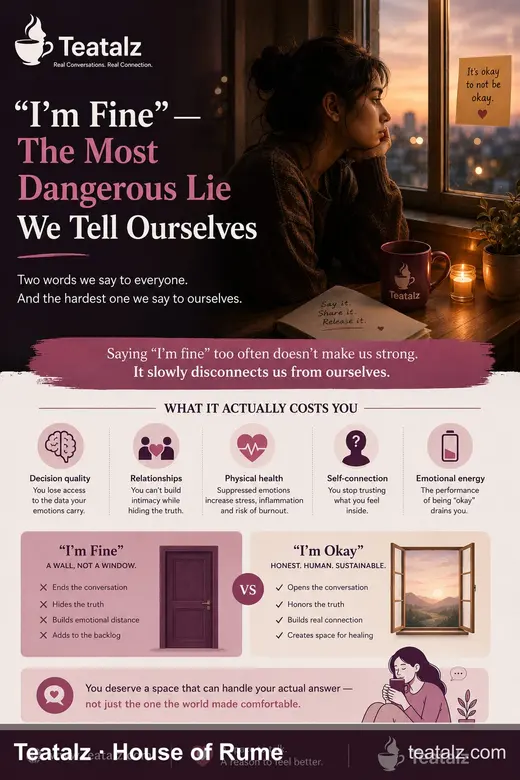
Let's be specific. Here is what chronic 'I'm fine' costs:
Decision quality: When emotional reality is suppressed, the information it carries gets suppressed too. Emotions aren't noise — they're data. Decisions made without access to your real emotional state are less accurate and often leave you feeling vaguely wrong even when they're logically sound.
Relationships: You cannot connect deeply with people while performing okayness. Real intimacy requires real honesty. 'I'm fine' keeps the lights on, but it also keeps the doors locked.
Physical health: The mind-body connection is not philosophy — it's physiology. Chronic emotional suppression is associated with elevated cortisol, inflammation, compromised immune function, and increased risk of burnout.
Your relationship with yourself: This is the one people underestimate. When you habitually deny your own experience, you start to lose trust in your own inner life. You stop knowing what you actually feel. And that disconnection from self is one of the most disorienting experiences a person can have.
The Difference Between Fine and Okay
Here's something worth sitting with: there's a difference between 'I'm fine' and 'I'm okay.'
'Okay' can be honest. Okay can mean: I'm not great, but I'm coping. I have hard things happening and I'm moving through them. I'm not where I want to be but I'm on my way. That's real. That's human. That's sustainable.
'Fine' is a wall, not a window. It's designed to end the conversation, not to open it.
The practice of replacing fine with okay — even just internally — is more radical than it sounds. It's the beginning of honesty. Of self-respect. Of actually being in a relationship with your own experience instead of managing it from a distance.
What Comes After Fine
At some point, for most people, 'I'm fine' stops working. The backlog becomes too large. The performance becomes too exhausting. Something — a loss, a breakdown, a random 3am moment of clarity — punctures the wall.
And what's on the other side is almost always the same thing: relief.
The relief of being real. Of saying 'I'm not fine and here's why.' Of being heard by someone — even if that someone is just yourself.
We don't have to wait for a crisis to get there.
The question is: do you have somewhere to put the truth before it becomes unbearable?
Because you deserve a space that can handle your actual answer — not just the one the world made comfortable.
────────────────────────────────────────────────────────────
When was the last time you said 'I'm fine' and meant the opposite? You don't have to share the details — just whether it happened. I think the answer might surprise us all.