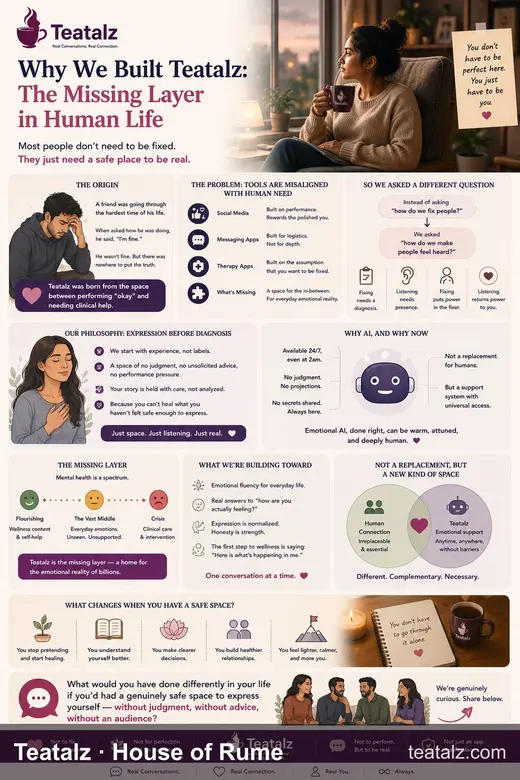
Every company starts with an origin story. Ours started with a conversation that didn't happen.
A friend — smart, successful, well-liked — was going through one of the hardest stretches of his life. Job uncertainty. Relationship tension. The quiet, grinding anxiety of feeling like he was performing 'okay' for the world while quietly coming apart inside.
And when asked how he was doing, he said: 'I'm fine.'
He wasn't fine. Everyone knew it. Including him. But there was nowhere to put the truth. His friends would worry. His family would overreact. A therapist felt like admitting something was seriously wrong. Social media was for curated highlights. And journaling felt like talking to himself in a room with no doors.
So he said he was fine. And he kept going.
Teatalz was born from the recognition that this gap — the space between performing 'okay' and needing clinical help — is where most people live, most of the time. And nobody has built anything real for it.
The Problem We Kept Coming Back To
When we started mapping the emotional landscape of modern life, one thing became clear very quickly: the tools we have for emotional processing are fundamentally misaligned with human need.
Social media is built on performance. It rewards the polished version of you. Vulnerability on social platforms is either commodified or used as engagement bait. Real emotional honesty — messy, unresolved, ugly — doesn't do well in the algorithm.
Messaging apps are built for logistics. 'Pick up the kids.' 'Can we reschedule?' 'Are you coming tonight?' They aren't built for depth. They're built for efficiency.
Therapy apps are built on the assumption that you want to be fixed. They route you toward diagnosis. They're clinical by design. That's a feature for the people who need them — but a barrier for the millions who don't yet know if they do.
Nothing was built for the in-between. For the person who isn't in crisis but isn't thriving either. For the daily experience of emotional reality that most of us navigate entirely alone.
So We Asked a Different Question
Instead of asking 'how do we fix people?' — we asked 'how do we make people feel heard?'
That single reframe changed everything.
Because fixing and listening are fundamentally different acts. Fixing requires a diagnosis. Listening requires presence. Fixing puts the power in the fixer. Listening returns the power to the person speaking. Fixing is transactional. Listening is transformational.
We decided to build a platform organized entirely around the second one.
The Philosophy: Expression Before Diagnosis
Teatalz is built on a core philosophical premise: most people don't know exactly what they're feeling until they try to express it. And they can't safely express it until they have a space that is genuinely safe — not safe in the terms-and-conditions sense, but safe in the emotional sense.
No judgment. No unsolicited advice. No performance pressure. No algorithm deciding whether your vulnerability is 'engaging enough' to show to an audience.
Just space. And listening. And the radical act of being taken seriously.
Expression before diagnosis means we don't start with labels. We start with experience. You tell us what's happening inside you — in your words, in your way — and we hold that with care before we offer anything else.
Why AI, and Why Now
We knew from the beginning that the scale of what we wanted to build required technology. Not because human connection isn't valuable — it's irreplaceable — but because human support has natural limits: availability, capacity, judgment, fatigue, relationship dynamics.
An AI listener doesn't get tired at 2am. It doesn't project its own anxieties onto your story. It doesn't change the subject because it's uncomfortable. It doesn't tell your secret to someone else. It doesn't need you to perform a certain way to make it feel good about helping you.
That's not a critique of human connection. It's an honest assessment of what a support system needs to be when the goal is universal access.
We also knew that emotional AI, done right, isn't cold or clinical. It can be warm. It can be attuned. It can ask the right question at the right moment. It can meet people in the middle of the night when nobody else is awake and make them feel less alone.
What 'Missing Layer' Actually Means
Think of mental health as a spectrum. At one end: flourishing, fully expressed, emotionally fluent. At the other end: clinical crisis, requiring intensive intervention.
The current infrastructure serves the extremes. Wellness content and self-help culture exist for the high end. Clinical services exist for the low end.
The vast middle — the daily texture of emotional life for billions of people — has no dedicated home.
That's the missing layer. And that's what Teatalz is here to fill.
Not as a stepping stone to therapy. Not as a replacement for real human connection. But as something that has never existed before: a space where your emotional reality is the product, not the user.
What We're Building Toward
We imagine a future where people have the same fluency with their inner lives that they have with their professional lives. Where 'how are you actually feeling?' gets a real answer. Where the gap between 'I'm fine' and 'I need help' is populated with support, not silence.
Where expression is normalized. Where emotional honesty is seen as strength. Where the first step toward wellness isn't walking into a therapist's office but simply being willing to say: here is what's happening in me. Here is what's true.
That's the world we're building toward. One conversation at a time.
We built Teatalz because nobody else did.
And because the people who needed it couldn't wait any longer.
────────────────────────────────────────────────────────────
What would you have done differently in your life if you'd had a genuinely safe space to express yourself emotionally — without judgment, without advice, without an audience? I'm genuinely curious. Share below.